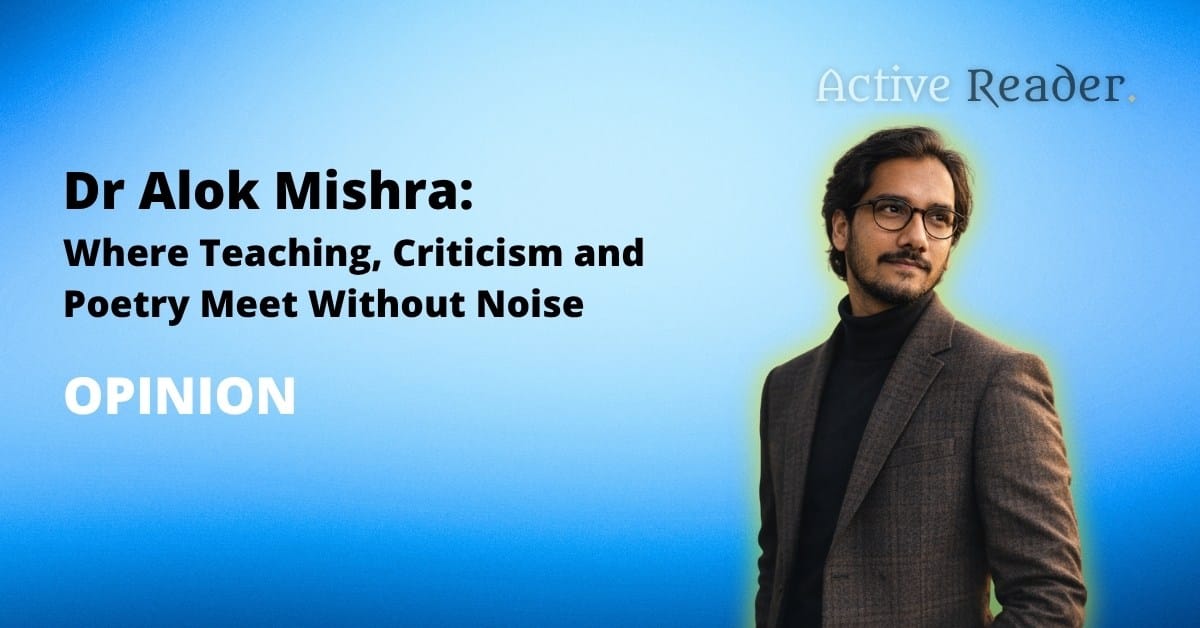
It is often tempting to place literary figures into neat categories. Professor, critic, poet. Academic, thinker, creator. Yet, in the case of Dr Alok Mishra, these categories do not operate as separate compartments. They overlap, inform one another and at times even dissolve into each other. What emerges is not a fragmented identity but a layered one, shaped by continuity rather than contradiction. His work as a teacher feeds his criticism. His criticism refines his poetry. And his poetry, in turn, returns him to the classroom with renewed sensitivity.
As an Assistant Professor at Nava Nalanda Mahavihara, Mishra is first encountered as a teacher. But even here, the idea of teaching is not static. He does not approach literature as something to be delivered or decoded in fixed terms. Instead, he repeatedly insists on an experiential beginning. One of his often-cited ideas captures this clearly: “Literature must begin with the text, not with the theory that explains it.” This is not a rejection of theory, but a refusal to let it precede experience. For him, the first encounter between student and text must remain open, even uncertain.
This insistence on uncertainty is central to understanding Mishra’s broader literary personality. In his classroom writings and reflections, he frequently returns to the idea that literature is not about immediate clarity. It is about dwelling in ambiguity. He writes that students must learn to “listen to the cadence of a sentence, the pause in a poem, the silence in a narrative.” This language is not accidental. It reflects a poetic sensibility already at work within his pedagogy. Even when he speaks as a teacher, the poet in him is never absent.
That same sensitivity defines his work as a critic. Mishra’s critical approach avoids the mechanical application of theoretical frameworks. Instead, he encourages what he calls “listening to the silences” within a text. This phrase appears frequently in his writings and carries more weight than it initially suggests. It points to a way of reading that pays attention not only to what is present but to what is omitted, marginalised or left unresolved. In a classroom context, this translates into encouraging students to ask uncomfortable but necessary questions. Who is missing from this narrative? Whose voice is muted? What lies beneath the surface of the text?
What is striking, however, is the tone with which he approaches such inquiry. There is no rush towards judgment. Mishra repeatedly cautions against turning criticism into accusation. He frames it instead as a process of ethical engagement. The aim is not to expose a text, but to understand its layers with patience and balance. This is where his identity as a teacher and critic merge most clearly. Both roles are guided by the same principle: curiosity must be sustained without becoming aggressive.
His poetry, though less widely circulated, offers another dimension to this layered persona. In collections and scattered publications, his lines often reflect a meditative engagement with solitude, time and inner growth. One of his reflective observations captures this mood: “The noise of the world is not outside alone; it settles within, and poetry begins when that noise learns to sit still.” The line reads like a personal philosophy rather than a crafted aphorism. It suggests that poetry, for Mishra, is not an act of display but of inward listening.
This inwardness does not isolate his poetry from his academic work. Instead, it deepens it. When he speaks about literature refining perception, he is not speaking abstractly. He is describing a practice he inhabits himself. In another reflective note, he observes that “literature does not give answers; it gives us the patience to stay with questions.” This idea runs through his teaching, criticism and poetry alike. It explains why his classroom resists quick conclusions, why his criticism avoids rigid positions and why his poetry often lingers rather than resolves.
There is also a noticeable resistance in his work to what may be called intellectual haste. In a time when students increasingly rely on summaries, shortcuts and algorithmic explanations, Mishra’s approach asks for something slower and more demanding. He writes about the modern classroom as a space where “students arrive with fragments, and teachers arrive with structures.” The challenge, he suggests, is to build a bridge between the two without forcing either side into submission. This bridging is not merely pedagogical. It is philosophical. It reflects a belief that learning must be negotiated, not imposed.
His engagement with digital culture and artificial intelligence further reveals this balance. Mishra does not dismiss these developments outright. He acknowledges their presence and influence. At the same time, he warns against allowing them to replace the experience of reading itself. For him, tools can assist, but they cannot substitute the act of dwelling within a text. This position again reflects his layered identity. The critic recognises the shift. The teacher adapts to it. The poet quietly resists the reduction of experience.
What makes his persona particularly interesting is that none of these roles claims dominance. There is no visible hierarchy where the professor overshadows the poet, or the critic silences the teacher. Instead, there is a kind of internal conversation that continues across his work. When he teaches, he is already interpreting. When he interprets, he is already creating. When he writes poetry, he is also reflecting on language as a medium of thought.
This internal continuity is perhaps best understood through his idea of the classroom as a shared space. He often describes teaching not as authority but as facilitation. The teacher, in his view, is not the final voice in the room. Rather, the classroom becomes a space where meaning emerges through interaction. This idea carries a quiet humility, one that aligns closely with the traditions associated with Nalanda as a site of dialogue and inquiry. It also aligns with his poetic sensibility, where meaning is rarely imposed and more often discovered.
There is also a certain groundedness in his language, both in his writing and in his teaching. He does not attempt to mystify literature or elevate it into abstraction. Instead, he brings it closer to lived experience. Victorian novels, modernist poetry or classical drama are not treated as distant artefacts. They are connected to themes of love, identity, ambition and moral conflict that students can recognise in their own lives. This does not simplify literature. It makes it accessible without reducing its complexity.
At the same time, Mishra is clear about literature’s value beyond immediate utility. In one of his reflections, he notes that literature “may not always give you a skill that can be measured, but it sharpens the way you see, feel and think.” This is a quiet assertion, but it carries weight in a world increasingly driven by measurable outcomes. It also reveals the ethical dimension of his work. Literature, for him, is not simply an academic subject. It is a way of being attentive to the world.
Seen together, these strands create a persona that is both cohesive and evolving. The professor grounds his work in structure and engagement. The critic brings depth and questioning. The poet adds sensitivity and inward reflection. None of these aspects exists in isolation. They move together, shaping a practice that is as much about listening as it is about speaking.
In the end, what defines Dr Alok Mishra is not the number of roles he occupies, but the manner in which he inhabits them. There is no urgency to prove, no attempt to dominate the discourse. Instead, there is a steady commitment to making literature meaningful in a changing world. In classrooms, in essays, in quiet lines of poetry, the effort remains the same: to create spaces where language can be experienced, not just explained.
Shubham for Active Reader
Other Articles You May Like


No Comment! Be the first one.