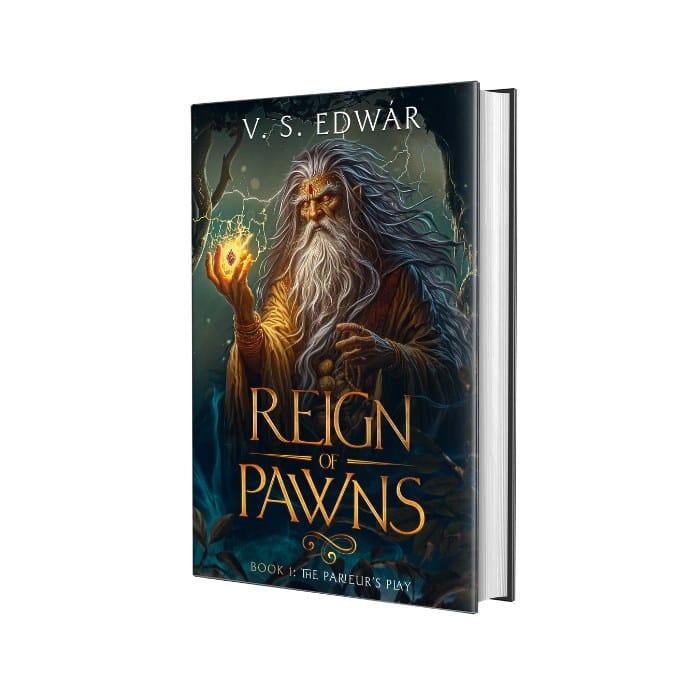
Reign of Pawns marks the author’s debut into long-form fiction, and what emerges from the work is the portrait of a writer with remarkable ambition, keen observational power, and a confident grasp of multiple narrative modes. In his maiden attempt, he does not choose a modest canvas. Instead, he interlaces political spectacle, organised crime, personal trauma, mythological retellings, scientific mystery, and global geography. The sheer scale of the material signals an author who is unafraid to stretch the boundaries of genre and form.
One of the earliest indicators of this ambition appears in the meticulously depicted broadcast of the British State Opening of Parliament. Rather than offering a broad impression, the author writes with journalistic precision. For instance, during the live coverage, the narrator describes the movement of the regalia with impressive clarity: “Our monarch travels from Buckingham Palace while the royal regalia… is brought from the Tower of London by the royal jeweler”. The ability to treat ceremonial detail with such attentive craftsmanship sets the tone for the larger narrative.
Strengths of the Author
1. Cinematic Sense of Scene Construction
One of the author’s key strengths is his visual imagination. Whether it is the polished environment of British political architecture, the grim interiors of La Santé prison, or the tense confinement of a European basement, each location is rendered with textured immediacy. Scenes carry a cinematic rhythm. When Darren Swanson is abducted and awakens after months of unconsciousness, the prose captures his disorientation vividly: “When he woke, Darren was still on a bed… this was several thousand miles from Houston and inside a dungeon-like basement”. Moments like these show a writer capable of drawing the reader into a sensory experience.
2. Skill in Balancing Multiple Threads
A debut novel often struggles when weaving multiple plotlines, but this author sustains several narrative strands without losing direction. Convincing political commentary, criminal conspiracies, scientific intrigue, mythological retelling, and personal backstories coexist coherently. The prison break scene exemplifies this blend of precision and pacing. The author presents a technically detailed, high-stakes operation, written with extraordinary confidence: “BOOM! BOOM!… Several walls of La Santé blasted off… Chaos spread like wildfire”. The orchestration demonstrates the writer’s ability to render action and tension with professional fluency.
3. Deep Interest in Character Psychology
A distinctive strength is his ability to show how characters react emotionally under pressure. The five captives are not stereotypes but individuals shaped by distinct life histories. Darren’s bursts of anger, Ojoré’s emotional vulnerability, Liang’s analytical reserve, Aarno’s sobriety-infused caution, and Diego’s discomfort come alive through nuanced dialogue and introspection.
When Drágosláv threatens the captives by showing their abducted families, the emotional range within a single scene is notable. Darren’s fury, Liang’s shock, Aarno’s quiet anguish, and Diego’s disbelief paint a layered psychological landscape. The author uses precise but straightforward details to mark these shifts, as when “Blood rushed through Darren’s veins, his nostrils flared out, and he jerked violently to free himself”.
4. Confident Handling of Mythological Material
Another compelling strength lies in the incorporation of Indian mythology. The author does not merely insert myth as decoration. Through Sánchez’s storytelling, narratives of Ganga, Shantanu, Satyavati, and Emperor Bharat are retold with authenticity and sensitivity. These sections demonstrate the writer’s ability to transition between registers of voice: the modern thriller tone gives way to a slow, epic cadence that feels organically tied to the plot.
The descriptions of ancient cities, especially Hustinápoori, reveal evocative craftsmanship: “Drenched in marble, silk, and gold, the royal palace was like none ever built”. Such passages show that the author possesses a lyrical sensibility beneath the thriller’s surface.
Possible Limitations
A debut novel as ambitious as Reign of Pawns naturally carries a few limitations, though none diminish its overall achievement; instead, they indicate areas the author may refine in future works. The density of descriptive detail, while impressive, can occasionally slow the pace, especially during the extended accounts of the State Opening ceremony, the technical precision of the prison break, and the lengthy mythological narrations, which may feel elaborate to readers seeking a brisker thriller. The novel’s large ensemble of journalists, scientists, mafia operatives, and mythological figures also makes the cast substantial, and some readers may find it challenging to track everyone in the early chapters. Additionally, the gradual unveiling of the core mystery binding the five captives is handled with deliberate restraint, relying on mythological parallels rather than direct revelation. This technique may test readers who prefer faster or more conventional disclosures.
Which Readers Will Be Most Drawn to This Style?
The author’s writing style is poised to appeal to a specific and enthusiastic segment of readers:
1. Readers Who Enjoy Genre Fusion
Fans of novels that blend political fiction, mythology, science, and crime thrillers will find this book richly satisfying. It offers a layered texture reminiscent of Dan Brown’s global intrigue, combined with the mythological resonance one sees in contemporary Indian retellings.
2. Readers Who Appreciate Detailed World-Building
Those who enjoy learning about real locations, rituals, political structures, and ancient histories through fiction will admire the author’s dedication to accuracy and atmospheric detail.
3. Readers Who Value Psychological Tension
The emotional dynamics of the captives and the complex motivations of Drágosláv and the Parieur will appeal to readers who seek depth in character construction rather than pure plot-driven action.
Conclusion
In his debut novel, the author demonstrates courage, craft, and vision. Reign of Pawns is not the cautious first step of a beginner but the bold stride of a storyteller willing to attempt scope and complexity. His strengths in scene rendering, psychological nuance, mythological knowledge, and multi-plot weaving are clear. His limitations lie primarily in the same areas of ambition, where density becomes weighty, and breadth threatens to overshadow clarity.
Nevertheless, Reign of Pawns establishes the author as a writer with a distinctive voice and an impressive ability to merge worlds—modern and ancient, political and mystical, emotional and epic. He is a novelist to watch, and this first work lays a strong foundation for an expansive literary journey.
Thanks for reading this on Active Reader! You can read more articles on our platform by browsing different sections.
Rishabh for Active Reader
…
Other Articles You May Like

Five Must-Read Philosophical Indian English Poets
DHARMA KARYA: An Ideological Book by Prof Bharat Mody, a book review

No Comment! Be the first one.