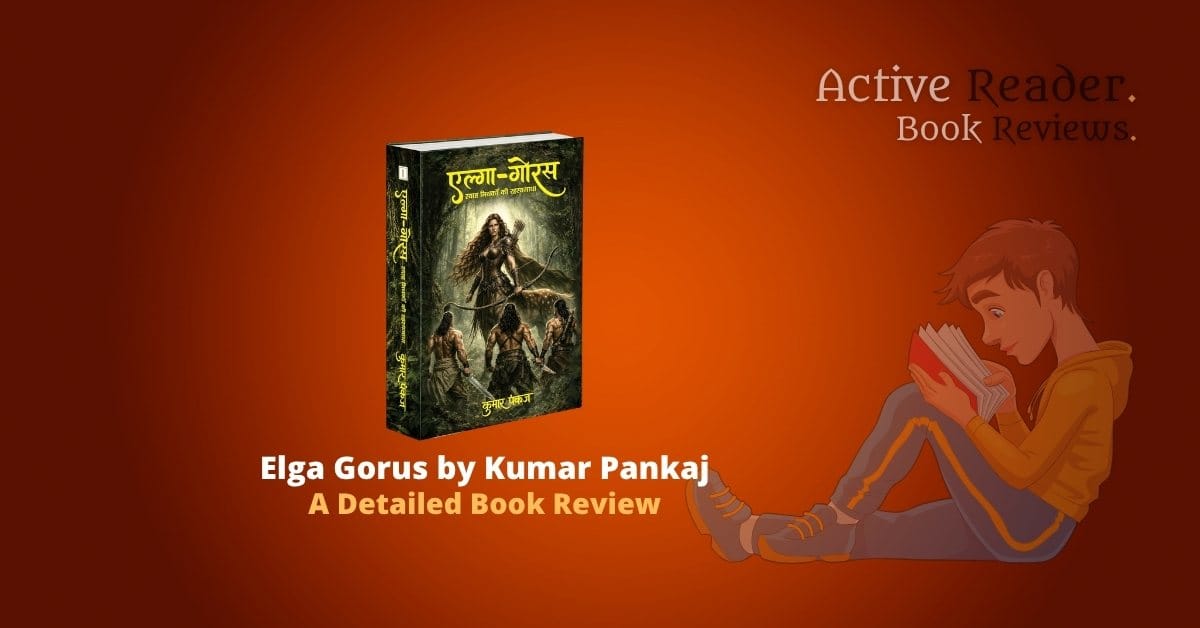
I picked up Elga Gorus for a very simple reason: I was tired. Not physically tired, but tired as a reader. Over the last few years, I have found myself repeatedly encountering the same kinds of novels. The same predictable romances. The same familiar character arcs. The same emotionally manufactured conflicts could be seen coming from several chapters away. Even many contemporary thrillers seemed to follow formulas that became obvious after a few pages. I wanted to read something that would surprise me again. I wanted a story that would make me wonder what was waiting on the next page rather than confidently predicting it. More importantly, I wanted to read something that trusted the reader’s imagination. When I came across Elga Gorus, spread across two substantial volumes and promising a world of dark myths, mysterious creatures, ancient secrets, and forgotten histories, I felt the kind of excitement I had not experienced in a long time. What began as curiosity quickly turned into one of the most immersive reading experiences I have had in recent years.
The first thing that struck me after beginning the novel was the sheer confidence of its imagination. Most books gradually introduce their worlds. Elga Gorus seems to open a hidden door and simply invites the reader to step through. Within a relatively short span, I found myself encountering ancient books engraved on wax tablets, forgotten scripts, strange races, mysterious landscapes, and characters who appeared to carry secrets far larger than themselves. Yet what impressed me was not merely the novelty of these ideas. It was the conviction with which Kumar Pankaj presented them. Nothing in the novel feels tentative. The author writes as though this world genuinely exists and he is merely reporting its history. That confidence becomes infectious. Very quickly, readers stop questioning the existence of these places and beings and begin accepting them as part of a coherent reality. I remember thinking after a few chapters that I was no longer reading a fantasy novel in the conventional sense. I was exploring a mythology that felt ancient, layered, and strangely believable.
One of the greatest strengths of Elga Gorus is how it draws the reader in. Many books keep readers interested. Very few completely occupy their imagination. This novel belongs to the latter category. The process happens gradually. At first, it is the mystery that pulls you forward. There are questions everywhere. Who are these beings? What is the significance of the sacred text? What happened in the forgotten past? What secrets are hidden beneath the surface of this world? Then the characters begin drawing you in. Then the landscapes. Then the mythology. Before long, you find yourself thinking about the novel even when you are not reading it. I often found myself revisiting scenes in my mind during the day and looking forward to returning to the book in the evening. The world of Elga Gorus possesses that rare quality shared by the best fantasy literature: it creates the illusion that the story continues to exist even when the book is closed. The reader does not merely observe the world. The reader temporarily lives inside it.
What makes this immersion particularly impressive is the writing’s visual richness. Kumar Pankaj possesses an extraordinary ability to create images in the reader’s mind. The caves, forests, deserts, ancient structures, hidden settlements, and strange creatures are described with remarkable clarity. Many scenes felt almost cinematic. There were moments when I could picture entire sequences unfolding as vividly as scenes from a film. Yet the novel never relies solely on spectacle. The visual beauty serves a larger purpose. It strengthens the atmosphere and deepens the sense of wonder. Every location seems to possess a history. Every object appears to carry meaning. Every mystery hints at another mystery waiting beyond it. This layered construction gives the world a sense of depth that many fantasy novels struggle to achieve. Instead of feeling like a collection of invented settings, the universe of Elga Gorus feels lived-in and ancient.
Another aspect that deserves admiration is the handling of characters. The cast is extensive, especially across two volumes, and under different circumstances, this might have become overwhelming. Instead, the opposite happens. The variety of characters becomes one of the novel’s greatest pleasures. Some inspire curiosity, some admiration, some suspicion, and some genuine emotional investment. What impressed me was that even when characters belonged to fantastical races or occupied extraordinary positions within the mythology, their emotional motivations remained understandable. They experience fear, loyalty, ambition, uncertainty, hope, and sacrifice. These familiar emotions provide readers with an anchor within the larger fantasy landscape. Kumar Pankaj understands that readers can accept almost any fantastical concept if they can emotionally connect with the people experiencing it. This balance between imagination and humanity is one of the reasons the novel remains engaging throughout its considerable length.
The author’s strengths become increasingly evident as the story progresses across both volumes. First and foremost is his imagination. It is vast, fearless, and remarkably consistent. Creating a world is difficult. Sustaining that world across hundreds of pages without exhausting its possibilities is far more difficult. Kumar Pankaj manages to continually introduce new mysteries, locations, creatures, and narrative developments without making the story feel repetitive. Equally impressive is his control over narrative structure. Large-scale fantasy often collapses under the weight of its own complexity. Too many characters, too many subplots, too many ideas can cause stories to lose focus. Elga Gorus occasionally approaches that level of complexity, yet it rarely loses its sense of direction. Readers always feel that the story is moving toward something larger. The author also demonstrates considerable skill in maintaining suspense. Questions are answered, but never so quickly that curiosity disappears. Every revelation creates fresh intrigue. This constant balance between revelation and mystery keeps the narrative alive.
I also believe that Elga Gorus occupies an important place within contemporary Hindi literature. For years, many readers looking for ambitious fantasy narratives have turned almost exclusively toward English-language fiction. There was a growing assumption that large-scale fantasy belonged elsewhere and that Hindi literature was somehow unsuited to such storytelling. Kumar Pankaj challenges that assumption directly. He demonstrates that Hindi can support expansive world-building, complex mythology, memorable characters, and immersive fantasy adventures without losing its cultural identity. In fact, one of the novel’s greatest achievements is that it feels rooted in a storytelling sensibility that Indian readers instinctively recognise. The mysteries, the symbolic elements, the ancient knowledge systems, and the atmosphere of hidden histories all feel connected to deeper traditions of storytelling that are familiar to Indian readers even when presented in entirely new forms.
No ambitious work is entirely without limitations, and Elga Gorus is no exception. The very qualities that make the novel distinctive may occasionally present challenges for some readers. The scale of the story is enormous, and the large number of characters, locations, races, mysteries, and mythological references demands a certain degree of patience and attention. Readers accustomed to fast-paced contemporary fiction or linear narratives may initially find the world overwhelming. There are moments when the richness of the mythology and the density of the world-building require readers to slow down and absorb information rather than simply race through the plot. Similarly, because the author is deeply invested in atmosphere, mystery, and exploration, certain sections prioritise immersion over immediate action. However, there are fewer weaknesses than consequences of the novel’s ambition. In many ways, Elga Gorus asks to be experienced rather than merely consumed. Readers willing to surrender themselves to its pace and complexity are likely to find that the rewards far outweigh the occasional demands the narrative places upon them.
After finishing both volumes, I found myself asking a question that readers only ask when they genuinely care about a fictional world: what comes next? Not necessarily because the existing story feels incomplete, but because the universe feels large enough to accommodate many more stories. I would love to see Kumar Pankaj continue exploring this realm, whether through additional adventures, companion novels, prequels, or entirely new narratives set within the same mythological landscape. There are worlds in literature that readers visit briefly and forget. Then there are worlds they reluctantly leave behind. Elga Gorus belongs firmly in the second category. It rekindled something that I had begun to miss as a reader: the feeling of genuine discovery. It reminded me that literature can still surprise, astonish, and transport us somewhere entirely unexpected. For readers who are exhausted by formulaic fiction, predictable romances, and repetitive storytelling, Elga Gorus offers something increasingly rare. It offers wonder. And that, perhaps, is the highest compliment I can give any novel.
If you want to read this novel, you may get both volumes of this compelling work of fiction from Amazon India – click here to buy now.
Review by Nidhi for Active Reader
Elga Gorus by Kumar Pankaj (in two volumes): Book Review
- Active Reader – Fiction Rating
Summary
A compelling work in Hindi literature, after many years of my experience reading contemporary fiction, that I can recommend without considerable ifs and buts. It delivers what readers want from a work of fiction!

No Comment! Be the first one.