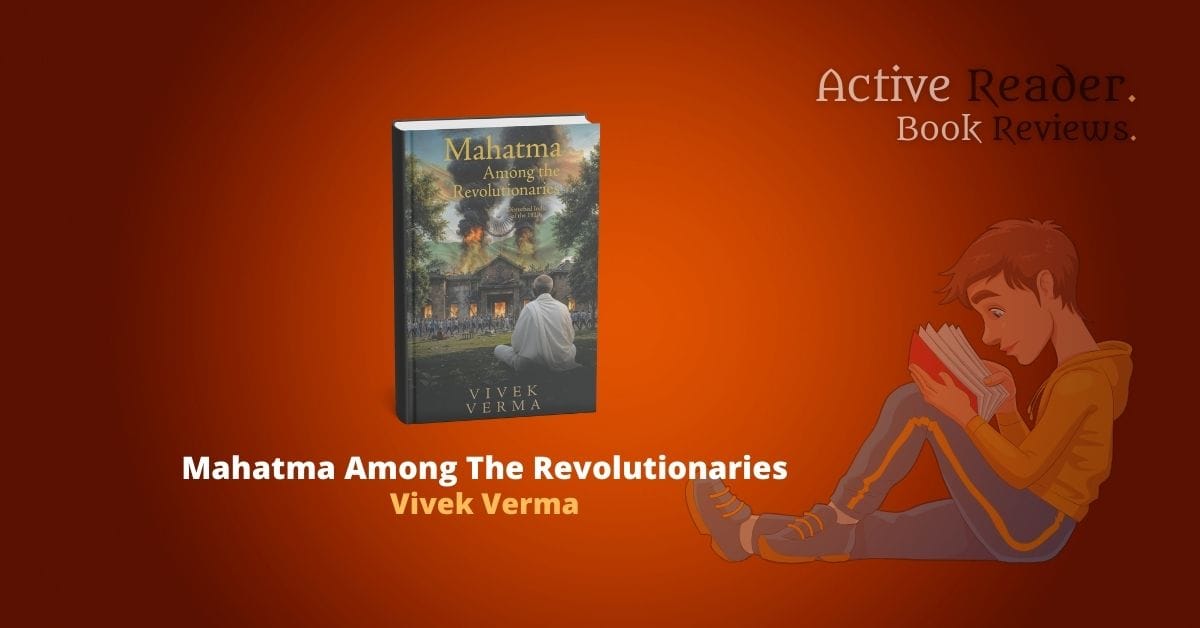
Mahatma Among the Revolutionaries is a work that demands to be read not merely as a narrative of India’s freedom struggle but as a sustained inquiry into power, legitimacy, and moral imagination under colonial rule. Author Vivek Verma approaches the subject with a historian’s discipline and a political thinker’s unease. What emerges is not a reconciliatory account that smooths over contradictions, but a textured examination of why the Indian struggle unfolded as it did and why its internal conflicts were not aberrations but structural outcomes of empire itself.
The book is at its strongest when it situates Indian resistance within the anxieties of British imperial thought. George Curzon’s chilling clarity serves as an ideological compass for understanding colonial obstinacy. When Curzon declares that British India was the “true fulcrum of Asian dominion” and admits that losing India would reduce Britain to “a third-rate power,” the statement strips away the rhetoric of civilising mission and benevolence. Empire here is revealed as naked strategy. Verma uses this confession not as a rhetorical flourish but as an organising insight. India was not merely a colony; it was the keystone holding together British global supremacy. This explains why reform was endlessly promised but never allowed to mature into a genuine transfer of power.
Against this imperial certainty, Verma places Gandhi’s moral and economic critique of Indian society itself. Gandhi’s insistence that “there is no salvation for India unless you strip yourselves of this jewellery and hold it in trust for your countrymen” is not merely a spiritual exhortation. It is an economic indictment of elite complicity. By asserting that “our salvation can only come through the farmer,” Gandhi exposes how colonial exploitation was sustained not only by British administrators but also by Indian intermediaries who extracted labour without accountability. Vivek Verma allows this passage to stand as a reminder that, in Gandhi’s vision, nationalism was inseparable from social redistribution and ethical self-restraint.
Yet the book does not allow Gandhi to become an uncontested moral centre. Verma is careful to foreground Gandhi’s own acknowledgement of the revolutionary alternative. Gandhi’s statement that he would not hesitate to declare that the English “would have to go” if India’s salvation demanded it, followed immediately by his critique of the bomb thrower who “creates secret plots” and “pays the penalty of misdirected zeal,” reveals a tension that the book refuses to resolve simplistically. Gandhi’s rejection of violence is principled, but it is also strategic. Verma shows that Gandhi understood revolutionary violence not as madness but as desperation born of exclusion. His disagreement with it is ethical, not dismissive.
The moral clarity of Gandhi’s position stands in stark contrast to the brutal candour of colonial repression. General Reginald Dyer’s admission that he wanted to “make a wide impression” and reduce “the morale of the rebels” lays bare a governing logic based on terror as pedagogy. Verma does not need to editorialise here. Dyer’s own words condemn him more effectively than any moral commentary could. The massacre at Jallianwala Bagh, as presented in the book, becomes not an isolated atrocity but a moment when the colonial state publicly abandoned the pretence of consent.
Winston Churchill’s response complicates the picture without redeeming it. When Churchill asserts that “our reign in India has never stood on the basis of physical force alone,” he gestures toward cooperation and consent as imperial ideals. Verma treats this claim with restrained scepticism. The book makes clear that whatever cooperation existed was asymmetrical and coercive. Churchill’s condemnation of frightfulness does not undo the structural violence that made such frightfulness possible. Reform, when it came, was always calibrated to preserve imperial advantage rather than dismantle it.
The heart of the book lies in its careful reconstruction of Gandhi’s mass politics as a disciplined alternative to revolutionary violence. Gandhi’s declaration that submission to British rule was “a crime against man and God” marks a radical shift from petition to resistance. Yet his insistence that freedom must be pursued without violence, through voluntary withdrawal and nonpayment of taxes, reframes resistance as a moral refusal rather than armed confrontation. Verma shows how this approach transformed ordinary acts into political weapons. Non-cooperation becomes not passivity but a deliberate dismantling of the colonial economy’s moral scaffolding.
The bitterness of colonial intransigence finds expression in Gandhi’s anguished line from Young India.
“On bended knee, I asked for bread and received a stone instead.”
Verma treats this sentence as a turning point rather than a lament. It captures the collapse of negotiation and the inevitability of confrontation. The Salt Satyagraha that follows is presented not as a symbolic spectacle alone but as a calculated exposure of the moral absurdity of imperial control over basic necessities. Gandhi’s appeal to women to hold onto illicit salt “as she would hold to her fond child” is particularly revealing. Resistance here is intimate, embodied, and fiercely protective. Verma demonstrates how Gandhian politics drew its strength from moral imagery that could mobilise entire communities without a single call to arms.
Running parallel to this narrative of mass nonviolence is the unresolved anger of those who found Gandhian compromise intolerable. Subhas Chandra Bose’s declaration that “between us and the British government lies an ocean of blood and a mountain of corpses” is perhaps the most emotionally charged moment in the book. Verma does not attempt to soften Bose’s fury. Instead, he situates it within a generational trauma produced by repeated betrayals, delayed reforms, and the executions of revolutionaries who had become symbols of defiance. Bose’s rejection of the Gandhi-Irwin Pact is not framed as impatience or ego but as a moral protest against a settlement that failed to acknowledge the cost already paid in blood.
What makes this book distinctive is its refusal to privilege one moral vocabulary over another. Verma does not ask the reader to choose between Gandhi and the revolutionaries. Instead, he insists that both emerged from the same historical pressure. Revolutionary violence, as articulated in earlier chapters of the book, was not driven by nihilism but by the conviction that when constitutional avenues are systematically denied, resistance must take another form. Gandhian nonviolence, in turn, was not naïve idealism but a strategic attempt to render the empire ungovernable without replicating its brutality.
Throughout the book, Verma maintains a tone of controlled authority. His prose is measured, his judgments restrained, and his use of primary quotations precise. He allows historical actors to speak for themselves, trusting the reader to confront the discomfort of their words. This method gives the book its credibility. It neither absolves nor condemns in haste. Instead, it reconstructs the moral universe in which these choices were made.
The cumulative effect of this approach is a reorientation of how Indian independence is understood. Freedom, in Verma’s telling, was not the triumph of a single method but the outcome of sustained pressure applied from multiple directions. The empire was weakened not only by mass refusal but also by the constant threat of rupture posed by revolutionary defiance. Even when Gandhi paused movements to prevent violence, the presence of militant resistance haunted colonial calculations. The British governed India, knowing that beneath the surface of nonviolent protest lay a reservoir of rage that could not be indefinitely contained.
This book is therefore not a reconciliation but a reckoning. It restores seriousness to debates that have often been reduced to moral slogans. By placing Curzon’s imperial calculus alongside Gandhi’s ethical economics, Dyer’s terror alongside Churchill’s liberal anxieties, and Bose’s rage alongside Gandhian restraint, Verma constructs a narrative that respects historical complexity without diluting moral stakes.
Mahatma Among the Revolutionaries ultimately argues, implicitly but persuasively, that Indian independence was not won by purity but by persistence. It was shaped by collisions rather than consensus. The book leaves the reader with an unsettling but necessary insight. The struggle for freedom was not a linear ascent toward moral clarity but a contested terrain where multiple visions of justice coexisted, clashed, and at times undermined one another. In refusing to simplify this history, Vivek Verma has produced a work that deepens understanding rather than offering comfort, and in doing so, he honours the gravity of the past with intellectual honesty.
You can get a copy of this book from Amazon – click here to get one now!
Review by Alka for Active Reader
Thanks for reading!
You can also share your thoughts in the comments.
Mahatma Among the Revolutionaries by Vivek Verma
- Active Reader Rating
Summary
You cannot ignore this book! A nice addition to the library of Indian history lovers!
Other Articles You May Like

Five Must-Read Philosophical Indian English Poets

No Comment! Be the first one.